A boutique content agency specializing in executive thought leadership had built a genuinely impressive service: for each client, they produced 24 finished assets per content cycle — video clips, graphics, and text posts — starting from a single recorded interview. The promise was high-output, low-friction content for busy executives.
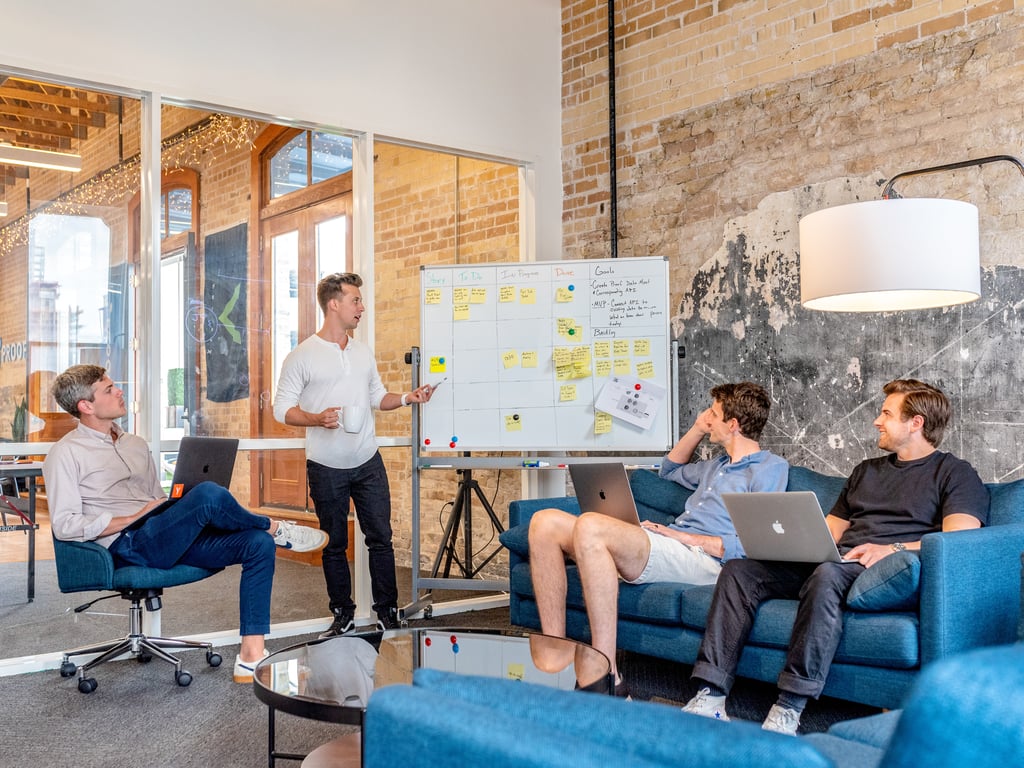
Content production workflow automation — Photo by Marvin Meyer on Unsplash
The delivery, though, was not low-friction. Not internally.
Every cycle began when a new recording landed and ended somewhere in a maze of manual steps: Airtable intake forms, Google Drive folder creation, Descript imports, ClickUp task setup, Claude prompts run by hand, Google Doc kit assembly, Metricool scheduling — all stitched together by a production team lead who knew exactly what needed to happen but had to do each step themselves.
The naming conventions didn't carry across platforms. Files had to be moved by hand from one tool to the next. There was no automated trigger from intake to task creation. Captions were generated manually per asset. The content calendar in Notion had to be populated by copy-pasting. Posting to Metricool was a final manual checkpoint before anything went live.
"Heavy manual processes throughout the workflow" was how the team described it at the start of the engagement. The production lead was the connective tissue — competent, fast, and entirely irreplaceable from the process. That's a fragile position to be in at scale.
What Made It Hard to Fix
The toolstack wasn't wrong. Airtable, Make.com, Google Drive, ClickUp, Descript, and Metricool are all capable platforms. The problem was that no one had ever connected them with intention. Each tool did its job in isolation. Data didn't flow. Files didn't move automatically. Nothing knew about anything else.
The agency had already attempted partial automation using Make.com, but the coverage was shallow. Client names in Google Drive didn't match client records in Airtable — string-based matching was failing for roughly 96% of records (approximately 192 out of ~200 client folders). When a recording arrived, the system couldn't reliably figure out which client it belonged to, so manual intervention was required to route it.
The pilot-phase toggle — needed for new clients but not for returning ones — had no automation logic. Every new engagement started with the same manual setup regardless of client history. Revision rounds, human approval checkpoints, and content delivery all required the team to remember where things were and what state they were in.
The Investigation
A Connex consultant reviewed the full production workflow across a series of live ZoomFlow sessions with both the agency's CEO and production lead. Over five recorded sessions spanning June–July 2026 (approximately 394 total minutes of work), the consultant mapped every handoff point, identified where data was failing to carry between systems, and tested multiple automation approaches in real time.
The primary technical challenge turned out to be the folder-matching problem. The agency's Google Drive had nearly 200 client folders, organized by the team over years, with naming variations that a simple string match couldn't handle. The consultant implemented an AI-confidence matching system inside Make.com — feeding the folder names and Airtable client records to a language model and having it assign confidence scores to candidate matches rather than requiring exact string equality. After testing two different AI models across multiple runs, the more accurate approach was identified and the backfill was run to populate parent folder IDs across all existing Airtable records.
What Was Built
Google Calendar webhook: When a client meeting is completed in Google Calendar, a Make.com webhook fires automatically. The system extracts the client name, looks up the matching Airtable record using the AI-confidence matcher, and routes the meeting transcript to the correct Google Drive client folder — no manual intervention.
Airtable contact backfill: Point-of-contact fields across ~200 existing client records were populated via a Make.com workflow that handles multiple contacts, uses upsert logic to avoid duplicates, and flags records that couldn't be matched for human review.
Intake-to-Drive folder structure: New client intake via Airtable form now triggers automatic folder creation in Google Drive, with naming conventions enforced by the automation. The folder IDs are written back to Airtable so every downstream step can find the files without searching.
Pilot-phase logic: The automation distinguishes between new clients (requiring pilot-phase assets) and returning clients, applying the correct task templates in ClickUp without manual selection.
AI caption generation: Captions for all 24 assets in a cycle are generated automatically using a Claude-powered prompt embedded in the workflow, eliminating per-asset manual runs.
Notion content calendar population: Scheduled content is written to the Notion calendar automatically from ClickUp task data, replacing the manual copy-paste step.
Estimated Impact
⚠️ The figures below are estimates derived from stated workflow specifics. No time-tracking data was available; figures are based on the production team's description of manual steps per asset and cycle volume.
The production team described the current process as requiring hands-on coordination across each of the 24 assets per cycle — file routing, naming, task setup, caption generation, and calendar entry. At a conservative estimate of 15 minutes of manual overhead per asset across those steps, a single content cycle required approximately 6 hours of production time beyond the actual creative work. At the agency's stated cadence of roughly 3 cycles per month across active clients, that's an estimated 18 hours per month of work that was procedural, not creative.
The folder-matching fix alone resolved a backlog of ~192 client records that had no reliable automated routing path. Before the engagement, every recording for those clients required manual lookup and routing. After: the match happens in seconds inside Make.com, with AI scoring the confidence and flagging low-confidence cases for human review rather than defaulting to manual-everything.
The agency can now onboard new clients without the production lead setting up each system by hand. The intake-to-folder-structure automation means the first hour of work on any new engagement is already done by the time anyone opens ClickUp.
What This Looks Like for a Prospect
If your service business delivers a repeatable output — a content package, a report, a project deliverable — and the production process relies on a specific person knowing where everything lives and what to do next, that's the pattern this engagement addressed.
The risk isn't that your team isn't good at the work. The risk is that the work depends on them being present, available, and keeping the whole map in their head. Automation doesn't replace the creative judgment. It handles the file routing, the record updates, the folder creation, and the calendar population — so the humans can focus on the parts that actually require humans.
Connex worked through this alongside the client's team, live on Zoom, building and testing in the actual tools. The client's production lead was part of every session — not handed a finished system to learn, but part of building it.
Ready to Automate Your Production Workflow?
If your team is holding together a multi-tool production process through manual steps and institutional knowledge, there's a better way. Connex helps service businesses map and automate repeatable workflows — the kind that currently depend on a specific person knowing where everything lives.
We work through it with you, live in your actual tools, until the automation handles the handoffs. Book a free discovery call to see what's possible for your workflow.