See how AI operations agents for small teams can handle development, support, SEO, and task handoffs while founders keep human QA and customer conversations.
AI operations agents for small teams can coordinate development, support, SEO, and internal handoffs while the founder stays responsible for judgment, customer conversations, and quality assurance.
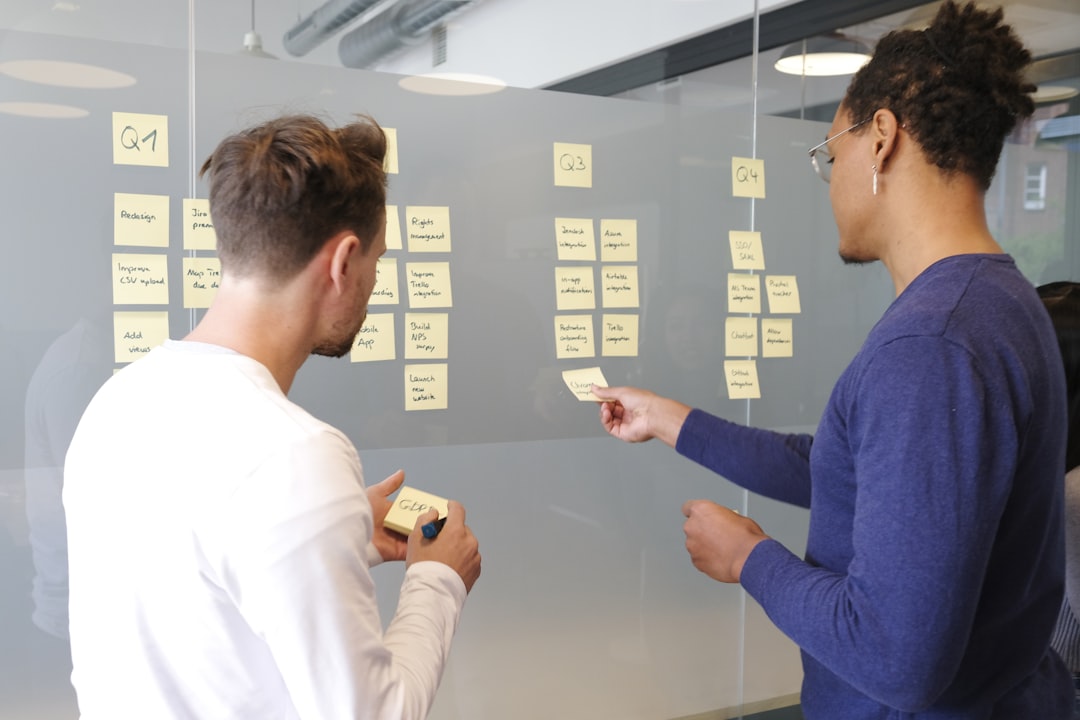
Two people planning work with sticky notes on a glass wall, the kind of task queue AI operations agents for small teams depend on. Photo by airfocus on Unsplash
That operating model is becoming practical for solo founders and small teams. The useful pattern is not “give an AI access to everything and hope.” It is a set of specialized agents connected to clear work queues, feedback loops, and a human review boundary.
What changes when a founder works with agents
A founder moving from a small team to a largely solo operation does not simply automate one repetitive task. The operating model changes in three ways:
Work is written down as discrete tasks instead of living in meetings or private context.
Agents pick up well-defined work when it reaches a ready state.
The founder reviews outcomes, handles ambiguity, and decides what should ship.
This creates more throughput without pretending that every decision can be delegated. The founder can run several workstreams at once but stays accountable for the product and the customer experience.
The core system behind AI operations agents
1. Start with a reliable task queue
The task tracker becomes the handoff layer between the founder and the agents. A Notion database works well for this. Each task should include the desired outcome, relevant context, constraints, and a clear definition of done.
When a task is ready, an agent can create an isolated work area, plan the implementation, and begin execution. This is more dependable than asking an agent to “find something useful to do,” because the queue provides both priority and scope.
The queue also preserves momentum when the founder is on a demo call, traveling, or reviewing another change. Work does not need to wait for a synchronous handoff.
2. Route questions through notifications
Autonomous work still needs a way to ask for clarification. A notification loop, built with Zapier or a similar tool, can send a short question to the founder’s phone when an agent reaches an ambiguous requirement, needs a permission, or encounters a decision that should not be guessed.
The goal is not to interrupt the founder constantly. It is to make interruptions specific and actionable:
“Should this behavior apply to all accounts or only new accounts?”
“The report has two plausible definitions. Which one should ship?”
“This change touches billing logic. Do you want a pull request or a draft only?”
Good notification design keeps the founder in control without requiring the founder to watch every terminal, inbox, or dashboard.
3. Build feedback loops around the business
The highest-value agents do more than generate text or code. They watch business inputs and move work forward.
A small team might connect agents to:
Customer support, where routine first-line questions receive a draft or an automatic reply.
Bug reports, where a legitimate issue becomes a proposed code change for review.
Search and analytics data, where recurring opportunities become content experiments or comparison pages.
Sales calls, where preparation notes and follow-up tasks are created before details are forgotten.
Each loop should have a narrow responsibility and an explicit escalation path. The agent can prepare, classify, draft, or propose. The founder decides when the cost of a mistake is high.
Why the human QA boundary matters
An agentic workflow increases the number of things a founder can attempt in parallel. It also increases the number of things that can finish at nearly the same time.
That makes review a first-class operating function. On a busy afternoon, a founder can be checking several shipped features, reviewing customer-facing copy, and validating a support response. The bottleneck moves from production to judgment.
Keep human review for work that affects:
Customer promises and pricing
Security, privacy, and permissions
Visual quality and user experience
Data migrations and irreversible changes
Public claims, SEO positioning, and brand voice
The practical rule is simple: automate the work, not the accountability.
How to manage several parallel workstreams
Running several workstreams means switching between tasks that are all moving at once. Without structure, this becomes a pile of half-finished work.
Use a small set of operating rules:
One source of truth for ready work. Agents should not infer priorities from scattered messages.
One owner for final decisions. Someone must resolve trade-offs and approve high-impact changes.
One status for blocked work. A blocked task should explain exactly what input is missing.
One review queue. Finished work should arrive somewhere the founder can inspect in batches.
One rollback path. Every automated change should be reversible or isolated until approved.
These rules matter more than the number of models, tools, or agents in the system.
Model choice and token budgeting
A small team does not need to commit every workflow to one model or one provider. Different tasks benefit from different strengths, such as code generation, summarization, planning, or careful editing.
What matters is routing and budget discipline, not brand loyalty. Track which tasks consume the most context, reserve capacity for remote or time-sensitive work, and avoid sending every low-risk action through the most expensive model.
A simple budget policy can include:
A monthly or weekly allowance for routine tasks
A reserve for travel, incidents, or launches
Smaller models for classification and routing
Stronger models for architecture, debugging, and final drafts
A rule for stopping or escalating when an agent loops
This turns model usage into an operating decision instead of an invisible variable cost.
What AI operations agents should not replace
The best small-team systems leave some work intentionally human:
Customer conversations that depend on trust or nuance
Product direction and positioning
Final QA on important changes
Decisions involving risk, reputation, or irreversible cost
Relationships that create partnerships, sales, and insight
A founder can use agents to arrive better prepared for a demo, keep follow-ups organized, and continue making progress during the call. That is different from removing the founder from the conversation.
A practical rollout plan
Start with one workflow that is frequent, structured, and easy to review. Support triage, bug intake, SEO research, or sales-call preparation are usually better starting points than an agent with broad authority over the whole company.
Phase 1: Document the handoff
Write down the trigger, required inputs, expected output, and escalation rules. If a human teammate could not follow the handoff, an agent will struggle too.
Phase 2: Run in draft mode
Let the agent classify and prepare work without sending messages, changing production data, or opening pull requests automatically. Measure how often the output is useful, incomplete, or wrong.
Phase 3: Add bounded actions
Allow the agent to take low-risk actions with clear limits. Keep approvals for customer-facing, financial, security-sensitive, and irreversible work.
Phase 4: Connect the next loop
Once one workflow is reliable, connect it to the next stage. For example, a support classification agent can feed a bug queue, and a resolved bug can produce a documentation or SEO update for review.
AI operations agents are most useful when they create a dependable rhythm: work enters a queue, an agent advances it, questions come back through a notification loop, and a human reviews the result.
That rhythm can give a solo founder or small team more capacity without hiding the trade-offs. The founder doesn’t disappear. They spend less time coordinating motion and more time making the decisions that require context.
Get help building AI operations agents for your team
Most small teams stall on the handoff design: what goes in the queue, when an agent should stop and ask, and where human review sits. Connex has helped 400+ companies automate operations with Notion, Zapier, and AI. Book a free discovery call and we’ll map your first agent workflow with you.
Build ai invoice automation that waits for job approval, updates vendors, then creates bills safely. Includes guardrails, idempotency, and a testing checklist.
Stop “ghost” Zap failures. Learn an AI-first repair playbook to audit legacy Zaps, fix broken connections, and ship safer auto-suggestions with human approval.